The opera and its puppets
The Magic Flute on marionettes
The story, the characters and the staging of Mozart's opera as the Salzburg Marionette Theatre performs it, and what the puppets add to it.
Book the Marionette Theatre ↗Quick answer
The Magic Flute is Mozart's German-language opera of 1791, and the Salzburg Marionette Theatre has performed it since 1952. A prince, a bird-catcher and a queen's daughter pass trials in a fairy-tale world, and the marionettes suit the story well. The full opera runs 2 hours 10 minutes with an interval, and a short version runs about an hour.
The story in brief
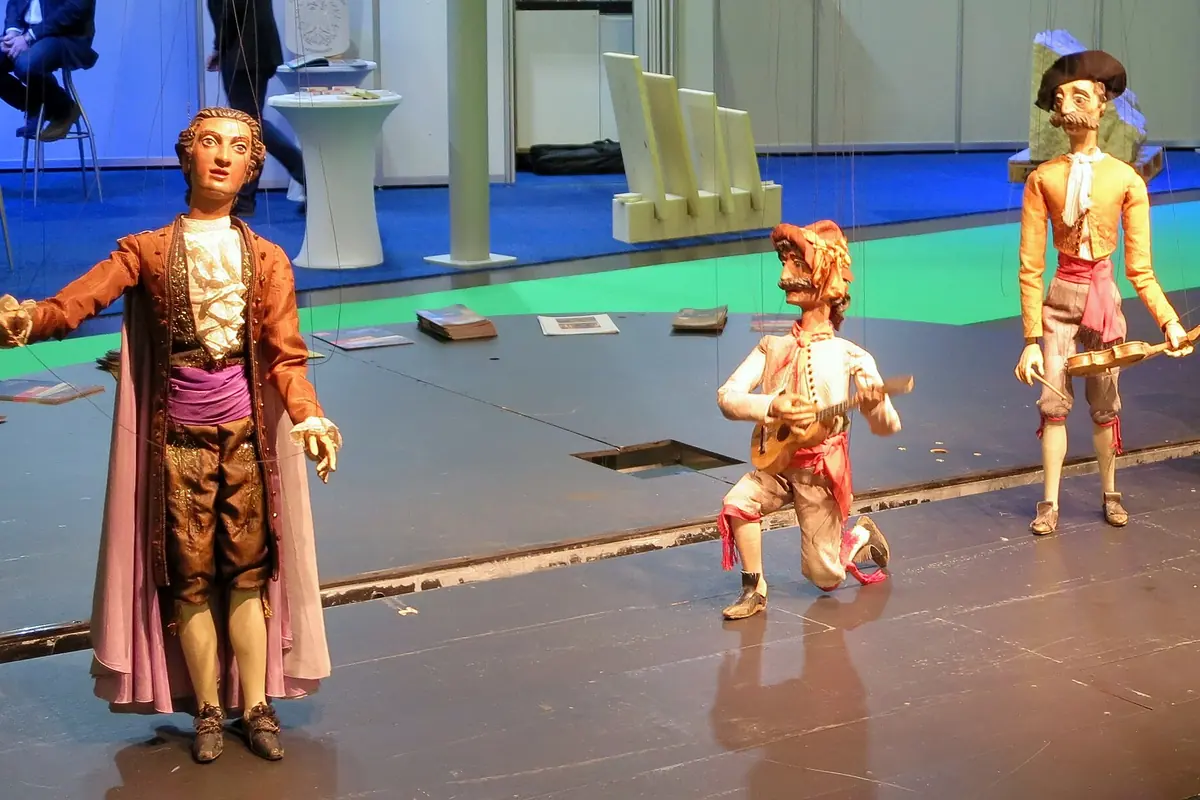
The Queen of the Night asks Prince Tamino to rescue her daughter Pamina, who is held by the high priest Sarastro. Tamino sets out with the bird-catcher Papageno. Tamino finds Pamina and the two fall in love, but they must pass several trials before they can be together. In the end Papageno also finds his Papagena. The Queen and her allies are defeated. The plot is a fairy tale about courage, loyalty and learning, which is why it works for adults and for children.
Who is who
Tamino is a tenor, Pamina a soprano and Sarastro a bass. Papageno, the bird-catcher, is the comic heart of the opera, and the Queen of the Night is a coloratura soprano whose vengeance aria is among the best-known numbers in opera. Papageno's bird-catcher song and Tamino's aria about Pamina's portrait are also famous. On the marionette stage each role is a figure made in the theatre's own workshops, and the characters read at a glance, even from the back of the hall.
Opera or play with songs?
Mozart called for sung numbers linked by spoken dialogue, a form known as Singspiel, and Emanuel Schikaneder wrote the German text. The first performance took place in Vienna on 30 September 1791, at the Freihaus-Theater auf der Wieden, where Schikaneder himself played Papageno. The opera's mix of comedy, spectacle and serious ideas helps explain why it sits so naturally with puppets. The Magic Flute is among the most frequently performed of all operas.
The Salzburg production
The theatre's Magic Flute opened in Boston in 1952 and became the company's most performed production. The set designs are by Günther Schneider-Siemssen and the costumes by Friedl Aicher, while the current staging is by Thomas Reichert. The puppets and equipment were made in the theatre's own workshops. The music is recorded, so what you see live is the puppeteers' work: figures turning, bowing and flying on strings in time with Mozart.
Read next: Salzburg Marionette Theatre tickets
What puppets add
A marionette cannot sing, and that is the point. The art lies in what the figure does while the music plays. Guests describe lifelike movement, a clear sense of character and moments of humour that land because the figures are small. The opera's fairy-tale scenes, such as the bird costumes, the trials and the appearance of the Queen, are the kind of material puppetry handles with a lightness that a stage with live singers has to work harder to achieve.
Seeing it where Mozart was born
Salzburg is Mozart's native city, and The Magic Flute is a permanent fixture in the Marionette Theatre's repertoire. The opera is also performed regularly at the Salzburg Festival, so the city offers it in more than one form. Seeing it on marionettes adds a local layer to a work most visitors know only from large stages: a small room, a fairy-tale opera and a company that has made Mozart its speciality for over a century.
Short or full version
The theatre performs the opera in a full version and a short one. The full version lasts 2 hours 10 minutes with an interval after the first act. The short version lasts about an hour and is recommended for adults and children from 8. Explanations in English, French, Spanish and Chinese are projected beside the stage in both cases, while the opera itself is performed in German. Choose the version when you book, and check the calendar, because the repertoire is seasonal.
Frequently asked questions
Is the Magic Flute performed in English?
No. It is performed in German, with explanations in English, French, Spanish and Chinese projected beside the stage.
Is the music live?
No. The company's soundtracks are recorded. The live element is the puppeteers working each figure on its strings.
Is The Magic Flute good for children?
Yes, the short version especially: the theatre recommends it for adults and children from 8. These tickets aren't suitable for children under 4.
Sources